
Images
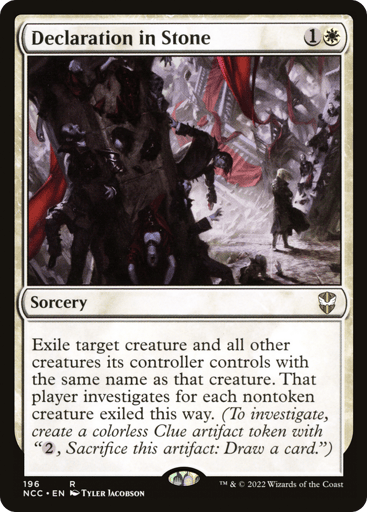
Declaration in Stone
name
mana_cost
Supertypes
supertypes
Types
Sorcery
types
Subtypes
subtypes
Select Variant
Data Sources1 Sources Online
Market Price Activity
SOURCE: --Status: Live
Loading...
Near Mint
$0.29
L: $0.15
Lightly Played
$0.24
L: $0.19
Moderately Played
$0.20
L: $0.24

// Scrydex may earn affiliate commission from these external links.
Details
Rules
Exile target creature and all other creatures its controller controls with the same name as that creature. That player investigates for each nontoken creature exiled this way.
rules
Power
power
Toughness
toughness
Color Identity
color_identity
Rarity
Rare
rarity
Number
196
number
Artist
Tyler Jacobson
artist
Language
English
language
(EN)
language_code
Expansion
New Capenna Commander
expansion.name
Rulings
A face-down creature, such as one cast with a megamorph ability from the Dragons of Tarkir set, has no name and can't share a name with any other creatures.
2016/04/08
Clue is an artifact type. Even though it appears on some cards with other permanent types, it's never a creature type, a land type, or anything but an artifact type.
2016/04/08
Declaration in Stone has only one target. The other creatures with that name aren't targeted. For example, a creature with hexproof will be exiled if it has the same name as the target creature.
2016/04/08
If an effect refers to a Clue, it means any Clue artifact, not just a Clue artifact token. For example, you can sacrifice Wrench to pay for Alquist Proft, Master Sleuth's activated ability.
2016/04/08
If the target creature is an illegal target when Declaration in Stone tries to resolve, it won't resolve and none of its effects will happen. No creatures will be exiled, including those with the same name as the target.
2016/04/08
It's possible to have a creature and a noncreature permanent with the same name, such as two copies of the same land, one of which has become a land creature. Only creatures with that name are exiled by Declaration in Stone.
2016/04/08
You can't sacrifice a Clue to pay multiple costs. For example, you can't sacrifice a Clue token to activate its own ability and also to activate Alquist Proft, Master Sleuth's ability.
2016/04/08
Unless a token is a copy of another permanent or was explicitly given a name by the effect that created it, its name is the subtypes it was given when it was created plus the word "Token." For example, if an effect creates a 1/1 Soldier creature token, that token is named "Soldier Token."
2022/06/10
rulings
Discussion
Code
Want to join the discussion?Sign In